Top 20 Largest Metropolitan Areas in the USA (2026): Population, Cities & Lifestyle Guide
Discover the top 20 largest metropolitan areas in the United States, from the busy streets of New York City to growing metropolitan regions such as Dallas, Houston, Atlanta, and Orlando.
These regions are home to millions of residents and offer diverse opportunities for employment, education, business, entertainment, and housing.
According to the latest available U.S. Census Bureau Vintage 2025 population estimates, New York is America's largest metropolitan area, followed by Los Angeles, Chicago, Dallas-Fort Worth, and Houston.
The figures below represent metropolitan statistical areas rather than populations within individual city limits.
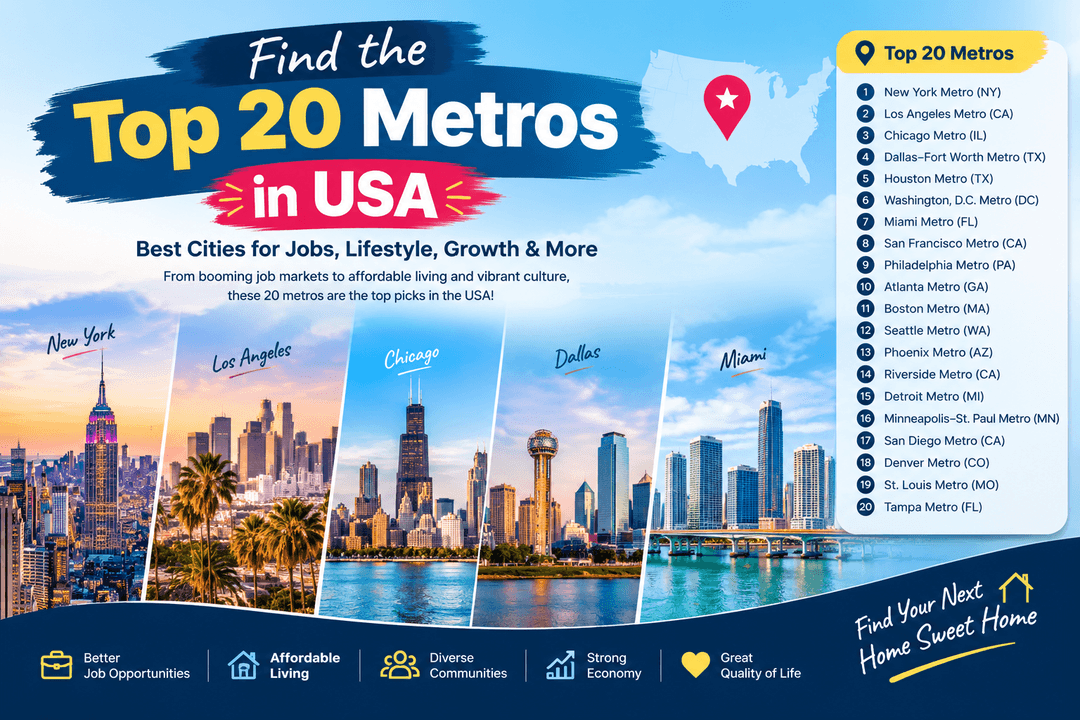
Top 20 Metro Areas in the USA by Population
The following ranking is based on U.S. Census metropolitan population estimates for July 1, 2025, rounded to two decimal places.
| Rank | Metropolitan Area | Population |
|---|---|---|
| 1 | New York-Newark-Jersey City, NY-NJ | 20.11 Million |
| 2 | Los Angeles-Long Beach-Anaheim, CA | 12.84 Million |
| 3 | Chicago-Naperville-Elgin, IL-IN | 9.43 Million |
| 4 | Dallas-Fort Worth-Arlington, TX | 8.48 Million |
| 5 | Houston-Pasadena-The Woodlands, TX | 7.90 Million |
| 6 | Atlanta-Sandy Springs-Roswell, GA | 6.48 Million |
| 7 | Washington-Arlington-Alexandria, DC-VA-MD-WV | 6.47 Million |
| 8 | Miami-Fort Lauderdale-West Palm Beach, FL | 6.39 Million |
| 9 | Philadelphia-Camden-Wilmington, PA-NJ-DE-MD | 6.33 Million |
| 10 | Phoenix-Mesa-Chandler, AZ | 5.23 Million |
| 11 | Boston-Cambridge-Newton, MA-NH | 5.03 Million |
| 12 | Riverside-San Bernardino-Ontario, CA | 4.77 Million |
| 13 | San Francisco-Oakland-Fremont, CA | 4.63 Million |
| 14 | Detroit-Warren-Dearborn, MI | 4.39 Million |
| 15 | Seattle-Tacoma-Bellevue, WA | 4.16 Million |
| 16 | Minneapolis-St. Paul-Bloomington, MN-WI | 3.79 Million |
| 17 | Tampa-St. Petersburg-Clearwater, FL | 3.42 Million |
| 18 | San Diego-Chula Vista-Carlsbad, CA | 3.28 Million |
| 19 | Denver-Aurora-Centennial, CO | 3.09 Million |
| 20 | Orlando-Kissimmee-Sanford, FL | 2.96 Million |
Source: U.S. Census Bureau, Vintage 2025 Metropolitan Statistical Area Population Estimates.
Exploring America's 20 Biggest Metro Areas
1. New York Metropolitan Area
Population: 20.11 Million
New York is the largest metropolitan area in the United States and one of the world's leading centers for finance, business, culture, and entertainment.
The region includes New York City, Newark, Jersey City, and surrounding communities across New York and New Jersey.
Known For: Wall Street, Broadway, international business, universities, cultural diversity, and extensive public transportation.
Living Here: Residents can choose from urban apartments, waterfront condominiums, historic neighborhoods, and suburban family communities.
2. Los Angeles Metropolitan Area
Population: 12.84 Million
Los Angeles is famous for Hollywood, beautiful beaches, entertainment, international trade, and multicultural living.
The metropolitan region includes Los Angeles, Long Beach, Anaheim, Pasadena, Santa Monica, and surrounding communities.
Known For: Entertainment, technology, tourism, fashion, creative industries, and international trade.
Living Here: Housing ranges from beachfront properties to hillside residences, apartments, and suburban communities.
3. Chicago Metropolitan Area
Population: 9.43 Million
Chicago is the largest metropolitan area in the Midwest and an important center for finance, transportation, manufacturing, education, and business.
Known For: Lake Michigan, historic architecture, financial services, universities, museums, and professional sports.
Living Here: The region offers downtown condominiums, lakefront properties, historic homes, and established suburban neighborhoods.
4. Dallas-Fort Worth Metropolitan Area
Population: 8.48 Million
Dallas-Fort Worth is one of America's largest metropolitan regions, with major corporate headquarters, growing suburban communities, and diverse business opportunities.
The area includes Dallas, Fort Worth, Arlington, Plano, Irving, Frisco, and nearby communities.
Known For: Technology, finance, corporate business, logistics, retail, and professional sports.
Living Here: Housing includes downtown apartments, planned communities, suburban houses, and luxury residential developments.
5. Houston Metropolitan Area
Population: 7.90 Million
Houston is an important center for energy, healthcare, aerospace, manufacturing, and international trade.
The metro includes Houston, Pasadena, The Woodlands, Sugar Land, and surrounding communities.
Known For: Energy, Texas Medical Center, aerospace, international business, and diverse cuisine.
Living Here: Residents can explore urban apartments, gated communities, suburban homes, and growing residential neighborhoods.
6. Atlanta Metropolitan Area
Population: 6.48 Million
Atlanta is a major business, transportation, and cultural hub in the southeastern United States.
The metropolitan area includes Atlanta, Sandy Springs, Alpharetta, Roswell, Marietta, and surrounding communities.
Known For: Corporate headquarters, technology, logistics, media, entertainment, and Hartsfield-Jackson Airport.
Living Here: Atlanta offers urban apartments, townhomes, established suburban neighborhoods, and spacious family residences.
7. Washington, D.C. Metropolitan Area
Population: 6.47 Million
The Washington metropolitan region extends across the District of Columbia, Virginia, Maryland, and West Virginia.
Known For: Federal government, international affairs, cybersecurity, technology, education, and historic attractions.
Living Here: The region offers walkable urban neighborhoods, town centers, and established suburbs.
8. Miami Metropolitan Area
Population: 6.39 Million
Miami is an international center for tourism, finance, culture, business, and real estate.
The region includes Miami, Fort Lauderdale, West Palm Beach, and surrounding communities.
Known For: Beaches, international business, hospitality, finance, cruise tourism, and multicultural living.
Living Here: Housing includes waterfront condominiums, luxury homes, high-rise apartments, and suburban neighborhoods.
9. Philadelphia Metropolitan Area
Population: 6.33 Million
Philadelphia combines American history with major healthcare, education, biotechnology, and financial industries.
The region extends across parts of Pennsylvania, New Jersey, Delaware, and Maryland.
Known For: Historic landmarks, healthcare, universities, biotechnology, finance, and cultural institutions.
Living Here: Residents can explore historic rowhouses, city apartments, suburban homes, and family-oriented communities.
10. Phoenix Metropolitan Area
Population: 5.23 Million
Phoenix is a major southwestern metropolitan area known for its desert landscapes, warm weather, and expanding business environment.
The area includes Phoenix, Mesa, Chandler, Scottsdale, Tempe, and Gilbert.
Known For: Technology, semiconductor manufacturing, healthcare, tourism, and outdoor recreation.
Living Here: Housing includes modern apartments, master-planned communities, suburban residences, and desert-view homes.
11. Boston Metropolitan Area
Population: 5.03 Million
Boston is internationally recognized for universities, research institutions, healthcare, and technology.
The region includes Boston, Cambridge, Newton, and nearby communities.
Known For: Harvard, MIT, biotechnology, medicine, finance, education, and historic landmarks.
Living Here: Residents can choose historic neighborhoods, urban apartments, coastal communities, and suburban homes.
12. Riverside-San Bernardino Metropolitan Area
Population: 4.77 Million
Known as the Inland Empire, the Riverside-San Bernardino region is an important part of Southern California.
Known For: Logistics, warehousing, manufacturing, distribution centers, and mountain recreation.
Living Here: The region offers suburban communities, larger residential lots, and neighborhoods near mountain and desert landscapes.
13. San Francisco Metropolitan Area
Population: 4.63 Million
The San Francisco-Oakland-Fremont metropolitan area is a major center for technology, innovation, finance, and international culture.
Known For: Technology, venture capital, financial services, universities, tourism, and innovation.
Living Here: Housing includes waterfront condominiums, urban apartments, hillside residences, and East Bay neighborhoods.
14. Detroit Metropolitan Area
Population: 4.39 Million
Detroit is internationally recognized for its automotive history and continues to support manufacturing, engineering, and mobility industries.
Known For: Automotive manufacturing, engineering, industrial design, music history, and cultural attractions.
Living Here: Residents can explore historic houses, suburban communities, modern apartments, and established neighborhoods.
15. Seattle Metropolitan Area
Population: 4.16 Million
Seattle combines technology and aerospace industries with forests, mountains, waterways, and cultural attractions.
The region includes Seattle, Tacoma, Bellevue, and nearby communities.
Known For: Technology, aerospace, e-commerce, coffee culture, ports, and outdoor recreation.
Living Here: The region offers waterfront homes, urban apartments, suburban neighborhoods, and mountain-view properties.
16. Minneapolis-St. Paul Metropolitan Area
Population: 3.79 Million
The Twin Cities region is recognized for corporate employers, healthcare institutions, parks, lakes, and cultural attractions.
Known For: Healthcare, financial services, retail, manufacturing, education, and outdoor recreation.
Living Here: Housing includes urban condominiums, historic houses, suburban developments, and lakeside neighborhoods.
17. Tampa-St. Petersburg Metropolitan Area
Population: 3.42 Million
The Tampa Bay region combines coastal recreation with business, healthcare, tourism, and education.
Known For: Gulf Coast beaches, financial services, healthcare, hospitality, tourism, and waterfront attractions.
Living Here: Residents can explore waterfront condos, suburban houses, urban apartments, and coastal neighborhoods.
18. San Diego Metropolitan Area
Population: 3.28 Million
San Diego is famous for its Pacific coastline, mild climate, outdoor activities, and science-driven industries.
Known For: Biotechnology, defense, healthcare, tourism, universities, and beaches.
Living Here: Housing ranges from coastal condos to suburban homes, city apartments, and hillside neighborhoods.
19. Denver Metropolitan Area
Population: 3.09 Million
Denver is a major economic center in the Rocky Mountain region with access to outdoor recreation and growing urban amenities.
Known For: Technology, aerospace, healthcare, business services, and the Rocky Mountains.
Living Here: Residents can choose downtown apartments, suburban homes, townhomes, and neighborhoods near parks and trails.
20. Orlando Metropolitan Area
Population: 2.96 Million
Orlando is internationally known for theme parks and tourism, while also supporting healthcare, education, technology, and expanding residential communities.
Known For: Walt Disney World, Universal Orlando, tourism, hospitality, entertainment, and aerospace-related industries.
Living Here: Housing includes suburban communities, family homes, modern apartments, and resort-style neighborhoods.
What Is a Metropolitan Area in the USA?
A metropolitan statistical area, commonly called an MSA, consists of a central urban area and surrounding communities that have strong economic and commuting relationships.
For example, New York's metropolitan population includes Newark, Jersey City, and numerous surrounding communities, not only New York City.
Similarly, Dallas-Fort Worth is a metropolitan region containing multiple principal cities and surrounding suburbs.
Metropolitan population figures provide a broader view of regional population and economic activity than city-proper figures.
Why Are Large Metropolitan Areas Important?
America's largest metropolitan regions bring together significant concentrations of employment, businesses, universities, healthcare facilities, cultural institutions, and residential communities.
- Employment Opportunities: Large metro regions often support a wide range of industries.
- Business Development: Metropolitan markets may provide access to larger customer bases and specialized services.
- Housing Choices: Residents can explore urban, suburban, and surrounding residential communities.
- Education: Many metropolitan regions contain major universities, schools, and research centers.
- Transportation: Large metros often serve as important transportation and logistics hubs.
However, a larger population does not automatically mean better affordability, job opportunities, or quality of life for every individual.
Frequently Asked Questions
1. Which is the largest metro area in the USA?
New York-Newark-Jersey City is the largest metropolitan area in the United States, with approximately 20.11 million residents in the 2025 population estimates.
2. What are the five largest metro areas in America?
New York, Los Angeles, Chicago, Dallas-Fort Worth, and Houston are the five largest metropolitan areas by estimated population.
3. Is Dallas bigger than Houston?
Yes, by metropolitan population. Dallas-Fort Worth has approximately 8.48 million residents, compared with Houston's 7.90 million.
City-proper population comparisons are different.
4. Is Atlanta among the top 10 metro areas?
Yes. Atlanta ranks sixth, with an estimated metropolitan population of approximately 6.48 million.
5. What is the difference between a city and a metro area?
A city is defined by municipal boundaries, while a metropolitan statistical area includes an urban center and economically connected surrounding counties.
6. Are these 2026 population figures?
These are the latest available official population estimates in 2026, measuring population as of July 1, 2025. They are not forecasts for December 2026.
Conclusion
The top 20 metropolitan areas in the USA represent some of the country's largest population centers and most influential business and cultural regions.
From New York's international financial industry to the expanding metropolitan communities of Dallas, Houston, Atlanta, and Orlando, each region offers different opportunities and lifestyles.
Whether you are researching relocation, employment, business opportunities, housing, or demographic trends, understanding metropolitan population rankings can help you make more informed decisions.
The right metropolitan area depends on your priorities, including affordability, career opportunities, transportation, climate, housing, and community preferences.